Trigger Warning: Financial stress, death, and suicide.
The years 2023–2025 were brutal—not just for me, but for many of us. If you’ve ever faced deep, multifaceted loss, you know how life can unravel from all sides. For me, this period began when my incredible father-in-law, Mike,—a beach-bum-turned-desert-dwelling icon of fatherhood—passed away two weeks before Christmas 2023. Though he was technically my husband’s step-dad (a label I’d never dare use in his presence), the 12-plus years he spent in my husband’s life profoundly shaped the man I affectionately call Lovey. In painful contrast, Lovey’s biological father—forever lost in his own world—never played that nurturing role. I miss Mike terribly and grieve that my sons will know him only in fragments of memory. He truly was the glue of this family—the family by marriage that I would choose over and over again, given the chance.
Cracks in the Foundation: Financial and Personal Turmoil
As if personal loss weren’t enough, my financial world collapsed when my employer stopped paying me—an issue now tied up in a lawsuit I won’t elaborate on here. To compound matters, my mother, who lives with me (to every fault of her own), began consistently skipping rent payments. None of these crises were part of the plan when I chose to return to school for my doctorate in 2022. Yet amid these challenges, I remain deeply aware of the privilege I still possess—and the responsibility to channel that into lifting and empowering others, which is precisely why I became a social worker. It’s complicated, realizing and acknowledging the privilege you have while honoring these adversities, all while still wanting to protect others from feeling the same. This tension is a huge factor in the moral injury and burnout that our field rarely addresses in real ways.

The Heavy Burden of Social Work
Then came January 2024: I lost a client to suicide. I’ve always known that working in mental health carried this risk. I spent my early years dreaming of being a teacher—from the first day of kindergarten until I was 21—wanting to pay forward the love and learning I received. But my flighty, restless mind needed constant learning and new challenges. After some encounters and mentoring, I boldly declared myself a social work major—a decision I will never regret. A leap of faith, if you will. I love being a social worker, but I’m angry that just to earn a living wage, I have to practice in the therapy realm, something I never truly wanted to do. Don’t get me wrong—I show up, I engage, I believe in the work I’m doing, and I genuinely care for my clients—but the level of responsibility for other human lives is not sustainable for me. If it was I wouldn’t have spent a decade in school to get a DSW, I would have been an MD. Maybe a chiropractor or a dentist. I do not believe anyone can manage that without immense cost.

Personal Struggles and the Weight of Identity
And then the wave of episodic depression continued into 2025. This February, my 19-year-old retired therapy cat, Miss Piggy Salsa Taco, took her final breath while lying on my chest. Her ashes now rest on my desk—a bittersweet reminder of a cherished companion who was with me for literally half my life. Each loss—every setback—deepened my depression and kept my baseline anxiety sky-high.

Growing up, school was my “thing.” I was praised for being smart—a “pleasure to have in class”—even though I was also known as the weird, loud, sometimes even “slutty” one by my peers. But when high school hit during one of the most tumultuous periods of my life—running away from my aunt’s home, feeling lost, burning out at 15—I struggled to be seen for who I truly was: kind-hearted, intelligent, and full of potential. Perfectionism and an identity tied to straight A’s eventually made school feel like a battleground for my self-esteem.
I once loved government class and political debates, yet history never quite captured me. How could I focus on AP American History when the world outside was so raw—when marriage, endless wars, attacks on arts and music, bullying, violence, and school shootings were happening right before our eyes? They say we must learn about history so that we don’t repeat it, but at the time, I saw it for the nationalist propaganda it was, without understanding or having the language to say that. My struggles in history class dealt a severe blow to my ego and sense of self.

A photo of myself as a senior in high school (and two of my friends, Kim, left, and Tanner, right).
Discovering Real History: A New Perspective
As an adult, I’ve come to appreciate “real history”—the kind that amplifies diverse voices instead of celebrating only the victors. It’s amusing that many of us are drawn to British history’s Victorian period, yet so much was happening around the world. This is Western-centrism in action. I found myself drawn to a history that isn’t whitewashed, but tells stories from across the globe, thousands of years before the founding fathers even existed. I’ve always been captivated by Cleopatra in mainstream media; Ancient Egypt, with its vibrant mystery and enduring legacy, beckoned me. Yet I’d never truly delved into it until I needed something to ground me in the storm of my emotions.
The Seed of Ancient Egypt: King Tut and Beyond
I remember learning about “King Tut” in sixth grade. I have a vivid memory of the photos and text in my textbook, of sitting on a portable classroom floor while others worked at their desks—this is where the seed was planted. Fast forward to today, and I’ve come to understand that King Tutankhamun (born Tutankhaten or Tutankhuaten) wasn’t the monumental figure modern myth portrays. He was a boy king who married his young sister and reigned for only about a decade. His successor, King Ay, actually tried to erase him due to religious fervor. This was an ancient form of making Egypt great again, by returning to the old ways, which incidentally enough, King Tutankhamun was all for. And yet, the modern fixation on King Tut remains—perhaps as a karmic echo of our need to remember. Ancient Egyptians believed that speaking a pharaoh’s full name—honoring his true identity—could secure immortality. Tutankhamun chose his ruling name carefully; it wasn’t his birth name. In speaking his full name—“living image of Amun” (with Amun eventually symbolizing the king of the gods, much like Zeus)—we honor not just him but the act of reclaiming a suppressed identity. It’s karmic. King Tutankhamun strove to display an image in stark contrast to his father, who had been branded a heretic for introducing monotheism to Egypt, aligning more with his grandfather’s traditional views. Some Egyptologists even suggest that King Ay, who may have murdered King Tutankhamun and even (allegedly) stole his burial chamber, has been nearly forgotten in the shadow of this legacy. It’s a kind of poetic justice that a relative “nobody” in his own time has become the most famous Egyptian king.
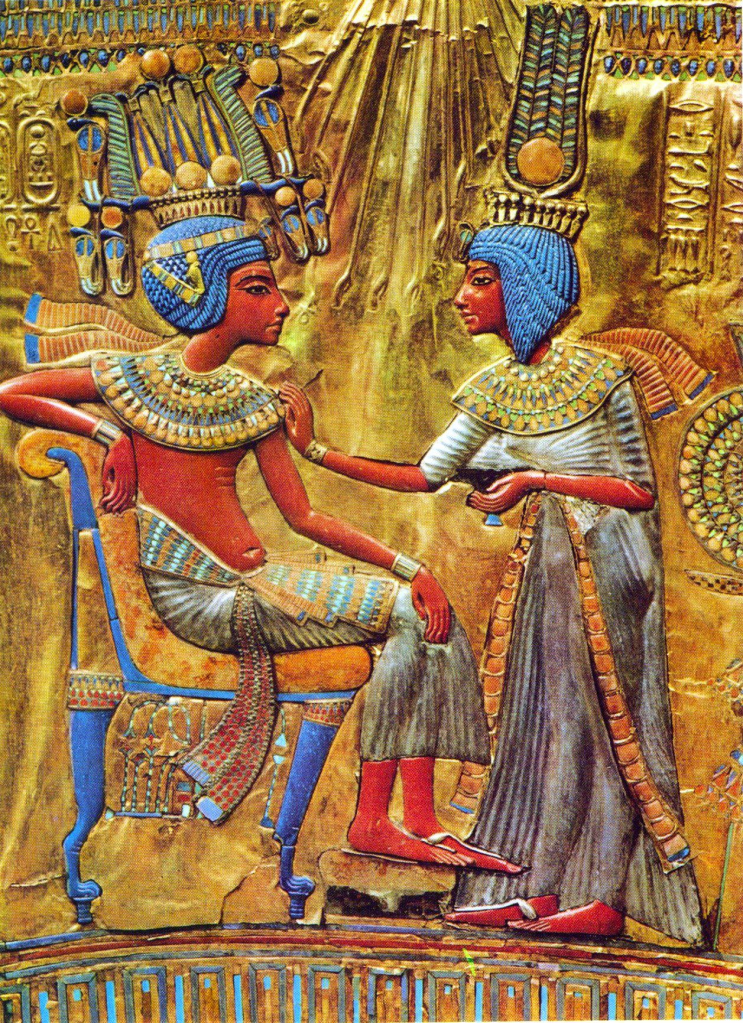
https://www.worldhistory.org/Tutankhamun/
Challenging Narratives: Names, Slavery, and Foreign Rule
I also had to confront a painful truth: the whitewashing and national self-absorption embedded in our historical narratives. Recently, I read a reflection on why names in Black communities are often labeled as “odd” or “difficult to pronounce.” One perspective traced this to slavery, suggesting that when enslaved people were stripped of their original names and given the surnames of their enslavers—Brown, Johnson, etc.—they held tightly to their first names as acts of self-definition and resistance.
But this telling doesn’t cover the full story. Many Black thinkers and critics have pushed back on that framing, reminding us that not everything should be flattened into a slavery narrative, and that it can still perpetuate a subtle form of cultural erasure. Black people were not passive recipients of names or liberation. They actively created meaning, reclaimed power, and named themselves in ways that reflected pride, connection, and vision. During the Civil Rights and Black Power movements especially, names became tools of empowerment—reflecting cultural lineage, spiritual depth, and defiant self-determination.
The truth is, it’s both—and more. Some names were chosen in hopes of reconnecting with lost family. Some were created to embody strength, uniqueness, and future dreams. Some were passed down across generations, carrying personal and communal meaning. What matters is that these names, whatever their origin, are not random. They are deeply significant—then and now.
There is no single narrative that can represent the entire Black experience. And that is precisely the point. Every name is a story. Every name is valid. It does not take much to learn to pronounce someone’s name correctly—and doing so is an act of respect, recognition, and solidarity.

Consider early immigrants: my own family’s “DiCarlo” became simplified to “Carlo.” Even today, many from Asia choose an Americanized name because mispronouncing their beautiful names—like Dikembe, Shigeru, or even Tutankhamun—feels like an attack on one’s identity. For me, using authentic names is a small act of resistance and reclamation, and it immortalizes the voices that might otherwise be silenced. Names are important and my thoughts on this will almost definitely find their way into this blog. In Ancient Egypt, names were of the utmost importance.
Another lesson from Ancient Egypt is the nuanced reality of slavery and labor. Contrary to popular belief, the pyramids at Giza—constructed during the Old Kingdom (around 2600–2500 BCE)—were built by paid workers who labored during slow agricultural seasons to sustain the economy. The first pyramid, built for Pharaoh Djoser nearly 4,700 years ago, set the precedent. Historian Herodotus, writing in the 5th century BCE, famously claimed that slaves built these wonders, but his account was colored by his own cultural biases and the vast gulf of time. Modern scholars agree that these monumental projects were more akin to a collective, state-organized endeavor—almost a socialist ideal—than a slave revolt. Misunderstanding this nuance only undermines our arguments about the pervasive impacts of slavery across time, and it oversimplifies complex issues such as the mischaracterization of ancient Egyptians as uniformly “black” or “white.” Ancient Egypt was much more diverse than history classes present. Egypt’s history is one of foreign rulers too—the Hyksos, Kushites, Assyrians, Persians, Greeks during the Ptolemaic Dynasty, and later Romans—all of whom influenced and reshaped Egyptian society.
A further lesson from Ancient Egypt is about foreign rule and assimilation. Early foreign rulers who did not assimilate often disrupted the local culture, whereas those who emerged from within or honored Egypt’s heritage were better received. This mirrors modern debates in the United States, a nation built on immigration, forced or otherwise, and the legacy of people who were enslaved. There is often a push for immigrants to assimilate, rather than for the U.S. government to grow and represent the true cultural makeup of the country. Ancient Egypt teaches us that embracing diversity while honoring tradition can lead to a more resilient, unified society.
And then there is the lesson of connection and community. Egypt was once ruled by two separate entities—Upper and Lower Egypt. When these were united under one pharaoh, it marked a turning point in Egyptian history. This uniting moment was vital: Egypt thrived when everyone was on the same page, when the government and the people worked together with mutual respect for each role. It’s a powerful metaphor for today’s world, where genuine connection and cooperation can pave the way for collective healing.

A Lesson in Feminine Power: The Legacy of Hatshepsut
No discussion of Ancient Egypt would be complete without mentioning King/Queen Hatshepsut. Unlike many women in history who ruled only by association, Hatshepsut reigned as a king in her own right for nearly 20 years during the 18th Dynasty—long before Cleopatra, who ruled as a consort through her father and brother. Hatshepsut did not derive her power from a man; she embodied it. Dr. Bob Brier brilliantly observes that “the way you become king in Ancient Egypt is by marrying the right woman”—a testament to the potent influence of female authority in a patriarchal context. Hatshepsut’s victories and her eventual challenges resonate deeply with modern struggles for mental health and empowerment among women. Her story is a powerful reminder that reclaiming power—despite societal constraints—is both possible and transformative.

Conclusion: Reclaiming Truth, Renewal, and Authentic Connection
My deep dive into ancient history has given me hope.
Recently, Senator Cory Booker broke the record for the longest recorded Senate speech since Strom Thurmond’s infamous 24-hour-and-18-minute filibuster against the Civil Rights Act of 1957. If Sen. Booker can stand in that chamber and claim victory across sixty-eight years of struggle—why can’t we go back thousands to reclaim something even bigger? Ancient Egypt is the only other civilization in history to have two comebacks. Why not us?
The United States can do it.
We can do it.
We can be raw and transparent in our conversations with friends, family, and co-workers—without labeling honesty as “unprofessional,” “difficult,” or “abrasive” just because it disrupts someone’s comfort zone. We can lift voices, share thoughts, and let people know they’re not alone—even in something as simple as a post. We can move energy in waves: in protest, in imagery, in music, in signs, in poetry. We can fight in ways that resonate with who we are.
When U.S. troops were sent away to wars overseas, people at home supported them in whatever ways they could. We can do that now—for each other. We can build pyramids, too. Not of stone, but of care, of solidarity, of truth-telling and world-building. We can support leaders who come from our communities, who care about people, who dream collectively.
And that—believe it or not—is how Ancient Egypt saved my mental health this year.
It started as a distraction. Something to interrupt the spiral. But it became more than that. It gave me something to think about, something to feel inspired by.
So now I ask you:
What has inspired you lately?
Not the heavy, serious stuff—but the simple, passionate things?
What have you turned to that made you feel alive again, and not just a zombie reawakened?
— BKay
Further Reading & Resources
- Dr. Bob Brier’s Work: For an in-depth exploration of ancient Egyptian culture and its modern-day implications, I highly recommend the research and writings of Dr. Bob Brier. His insights help contextualize how history is constructed and reinterpreted over time.
- Smithsonian’s Egyptian Collections: The Smithsonian Institution offers a treasure trove of resources and exhibits on Ancient Egypt.
- For a Nuanced View on Pyramid Construction: This BBC article on pyramid construction provides an excellent overview of current archaeological perspectives.
- Egyptology Feed on BlueSky: For ongoing insights and engaging discussions in Egyptology, check out the Egyptology Feed on BlueSky by @wellmanneredxs.bsky.social.

 Welcome to BKay's Brain
Leave a comment